


Sustaining Wood Fiber Resources Through Harvesting and Forest Regeneration
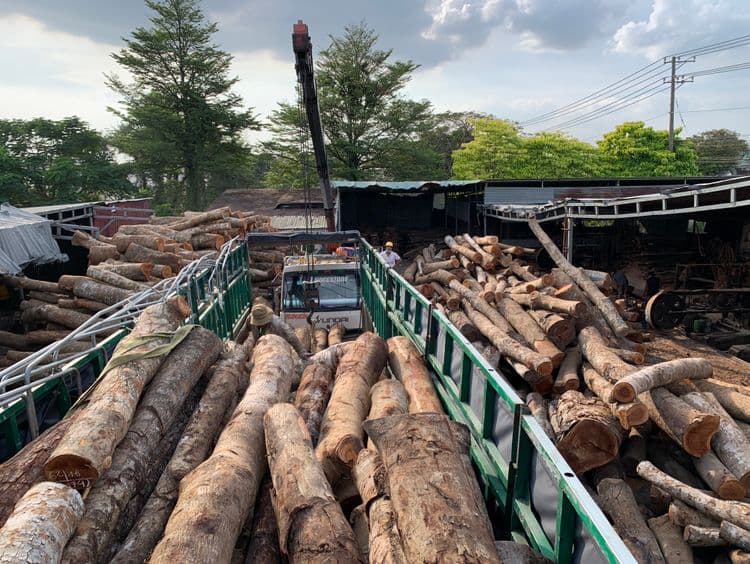
Discover how sustainable wood fiber production operates through structured plant-maintain-harvest-replant cycles and science-based forest regeneration.
Source: Pexels (Image for illustrative purposes only)
When seeing trees felled in an Industrial Plantation Forest (HTI) concession, many of us immediately associate the act with deforestation. In reality, timber harvesting is an integral phase of sustainable forest management—provided it is followed by structured replanting and planned forest regeneration.
This cyclical approach forms the foundation for securing sustainable wood fiber, the primary raw material for various downstream industries ranging from paper manufacturing to processed wood derivatives.
How the Plant, Maintain, Harvest, and Replant Cycle Works
According to Dr. Farah Diba, Dean of the Faculty of Forestry at Tanjungpura University, timber utilization should not be viewed as an inherent threat to forest sustainability. The underlying principle is straightforward: plant, maintain, harvest, and replant.
When executed rigorously, commercial timber production coexists with ecological forest functions. This principle ensures wood fiber continues to be produced without degrading the ecosystem.
Every harvested compartment must be regenerated according to scheduled silvicultural timelines. Timber harvesting is therefore not the terminal phase of forest operations, but the starting point of the subsequent rotational cycle.
Why Rotational Silviculture Has Long-Standing Roots
The plant-harvest-replant framework is not a novel concept. Since the era of Forest Concession Rights (HPH) in the 1970s, Indonesian forestry policies have organized concession areas into annual work blocks (RKT).
Each harvested block was legally mandated to undergo systematic reforestation. By the time harvesting returned to the initial block—historically after roughly 30 years—the replanted stand was expected to have matured for sustainable secondary rotation.
In essence, planned regeneration has formed part of national forestry policy long before modern environmental sustainability entered widespread public discourse.
Lessons From Past Regeneration Failures
History provides clear lessons regarding the risks of neglected replanting. In several historical instances, systemic failures to replant harvested areas led directly to raw material shortages for wood processing mills, eventually forcing operations to cease entirely.
These cases demonstrate that raw material security is not merely a function of total land area under concession. An equally critical determinant is operational consistency in achieving successful regeneration over time.
Why Science-Based Forest Management Is Indispensable

Source: Pexels (Image for illustrative purposes only)
To ensure silvicultural operations adhere strictly to scientific standards, PT Mayawana Persada (MP) collaborates with the Faculty of Forestry at Tanjungpura University.
This institutional collaboration encompasses multidisciplinary academic research across critical forestry domains:
- Forest conservation
- Forest product technology
- Silviculture
- Forest management
This science-driven approach serves as an operational guide for managing production blocks. Backed by empirical research, harvesting and replanting cycles are continuously audited, evaluated, and refined to match dynamic field conditions.
Integrating Ecology and Economics
A fundamental consensus among forestry scholars is that ecology and economics must not be treated as opposing forces. An operational model where commercial output thrives while ecological health degrades reflects structural management failure.
Sound environmental governance balances both dimensions. In commercial plantation forestry, the long-term viability of timber supply directly depends on preserving the underlying ecological integrity of the land where it grows.
Key Benchmarks for Sustainable Production Forestry
The performance of an industrial plantation forest should never be judged solely by the sheer volume of timber harvested. A more comprehensive metric is the capacity to maintain landscape sustainability while safeguarding environmental assets for future generations.
This standard is realized on the ground through the disciplined cycle of planting, tending, harvesting, and replanting—ensuring that every felled tree is matched with active regeneration.
At MP, this continuous workflow is driven by three interconnected operational divisions:
- Harvesting, responsible for controlled, efficient timber extraction.
- Plantation, overseeing silvicultural care and stand maintenance.
- Nursery, supplying high-quality, plant-ready seedlings.
These three divisions operate in an unbroken chain, ensuring that every harvested compartment enters the reforestation phase without delay.
Harvesting and Regeneration: A Unified Sustainable Cycle
Timber harvesting and ecological regeneration are not conflicting objectives; they represent two essential sides of a single, well-managed forestry system. As long as the plant, maintain, harvest, and replant rotation is consistently enforced, sustainable wood fiber can be produced indefinitely while protecting vital ecological landscapes.
To learn more about industrial plantation forestry (HTI) harvesting operations led by PT Mayawana Persada (MP), explore our comprehensive documentation on forest management and regeneration practices.
FAQ
What is the core principle of sustainable wood fiber production?
The core principle is the continuous cycle of planting, maintaining, harvesting, and replanting, treating timber utilization as a functional phase of sustainable forestry governed by disciplined regeneration.
How far back does rotational forestry go in Indonesia?
The model has been embedded in national forestry frameworks since the HPH concession system of the 1970s, which divided concessions into designated annual operating blocks mandated for reforestation post-harvest.
What are the consequences of failing to regenerate harvested forests?
Failing to replant harvested areas leads to raw material depletion, which historically caused processing plants to exhaust their fiber supply and permanently halt operations.
How does scientific research support fiber sustainability at MP?
MP collaborates with the Faculty of Forestry at Tanjungpura University across multidisciplinary fields, including forest conservation, wood product technology, silviculture, and forest management.
How does MP coordinate its plant-harvest-replant operations?
MP coordinates operations across three integrated divisions: Harvesting handles extraction, Plantation manages silvicultural care, and Nursery ensures a steady supply of viable seedlings, enabling immediate replanting across harvested blocks.
Read also
 Environment & Biodiversity
Understanding Peatland: Characteristics and Environmental Importance
Read more Environment & Biodiversity
Sustainable Forest Management: The Core Pillar of Forest and Environmental Conservation
Read more Operations & Field Activity
Enhancing Water Governance and Peatland Hydrology Management
Read more