


Understanding Orangutan Habitats: Distribution Facts and Conservation Efforts
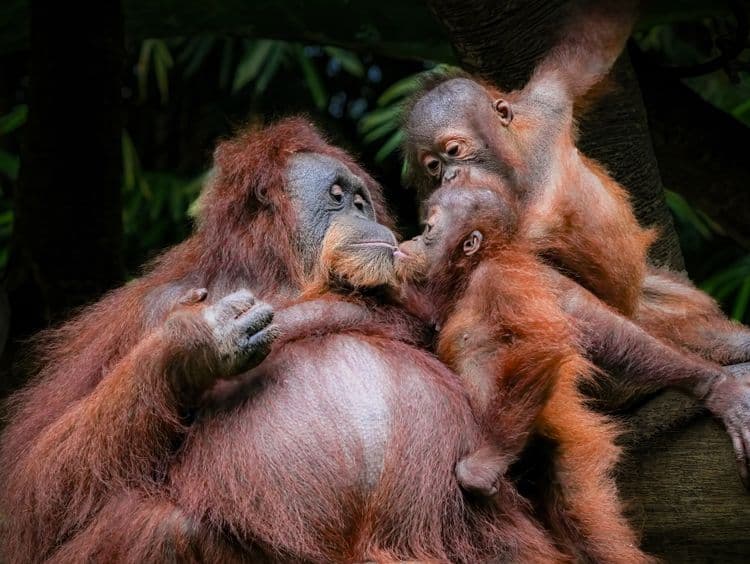
Discover what makes a viable orangutan habitat, species distribution in Indonesia, and science-based conservation efforts within forestry concessions.
When hearing the phrase "orangutan habitat," many of us instinctively picture a vast expanse of lush, towering trees. However, forested land alone is not enough to qualify as a viable habitat. Specific ecological criteria must be satisfied—from year-round food availability and viable breeding grounds to functional wildlife corridors connecting fragmented forest patches.
What truly constitutes a habitat capable of sustaining orangutan life? How does biodiversity research help pinpoint the areas that must be preserved? Here is the complete breakdown.
What Do Orangutans Need in Their Habitat?
Simply put, an orangutan habitat is a forest ecosystem that sustainably fulfills the species' survival needs, rather than serving as a temporary transit point. To function effectively, an orangutan habitat requires several vital conditions:
- Year-round food availability, especially diverse, fruit-bearing tree species distributed across the landscape.
- Continuous forest canopies, allowing orangutans to travel arboreally between tree crowns.
- Low-disturbance zones, essential for successful breeding and rearing offspring.
- Connected movement corridors, ensuring individual populations do not become geographically isolated.
These elements are deeply interdependent. Without adequate nourishment, orangutan populations cannot survive. Meanwhile, without connected dispersal corridors, sub-populations risk isolation, threatening their long-term genetic health and viability.
Where Are Orangutans Distributed in Indonesia?
Indonesia is home to three distinct orangutan species: the Bornean orangutan (Pongo pygmaeus), the Sumatran orangutan (Pongo abelii), and the Tapanuli orangutan (Pongo tapanuliensis), which was formally identified more recently in North Sumatra.
All three species inhabit the tropical rainforests of Borneo and Sumatra, including zones that overlap with commercial forestry concessions and agricultural plantations.
Unfortunately, each species faces ongoing pressures from the steady decline of natural forest cover over the years. This reality makes landscape-level management by land-based enterprises increasingly vital.
The presence of orangutans near operational areas demands an approach that incorporates their ecological requirements from the earliest planning stages—ensuring conservation is an integral operational pillar rather than an afterthought.
How Biodiversity Research Identifies Orangutan Habitats
PT Mayawana Persada (MP) serves as an example of science-based conservation within an industrial forest plantation (HTI) concession through its collaboration with the Faculty of Forestry at Tanjungpura University.
Biodiversity assessments were conducted by deploying approximately 40 camera traps across strategic locations. This method was combined with systematic vegetation surveys and spatial mapping of potential wildlife habitats.
This data-driven approach is critical because decisions regarding which areas to preserve are not grounded in assumptions. Empirical field data provides an objective, academically rigorous foundation for evaluating an ecosystem's ecological functions.
Why Mother-and-Infant Sightings Serve as Key Indicators
A pivotal finding from this research was the documented presence of orangutans, notably mothers accompanied by dependent infants, within the monitored landscape.
This finding strongly indicates that the area continues to supply sufficient food resources and provides an ecosystem capable of supporting reproduction and infant rearing. Orangutan mothers invest prolonged periods in raising their young, making landscape stability a decisive survival factor.
Capturing mothers with offspring on camera traps also confirms that these primates are not merely passing through; they are utilizing the territory as a long-term home range.
Why HCV Areas and Orangutan Corridors Must Be Preserved
Based on research findings, a primary recommendation is safeguarding High Conservation Value (HCV) areas as functional wildlife reserves, strictly exempting them from commercial timber operations.
Alongside protecting HCV blocks, establishing dedicated wildlife corridors is an essential recommendation to maintain landscape connectivity. Corridors bridge conservation blocks otherwise divided by operational production sectors.
Without adequate habitat corridors, orangutan populations risk fracturing into small, isolated clusters—sharply lowering their prospects for long-term survival.
What It Takes to Protect Orangutan Habitats
Safeguarding orangutan habitats requires far more than drawing boundaries on a concession map. It demands a suite of consistent, field-level actions:
- Biodiversity research to evaluate baseline habitat health.
- Targeted wildlife monitoring using appropriate methodologies, including camera traps.
- HCV area protection to secure primary wildlife sanctuaries.
- Corridor development to maintain landscape-wide ecological connectivity.
- Academic collaboration to guarantee objective, data-driven management.
- Field implementation that systematically adheres to scientific recommendations.
For enterprises operating alongside wildlife habitats, an evidence-based approach is indispensable for balancing commercial production with ecological stewardship. Through these disciplined practices, securing viable orangutan populations remains an essential priority in sustainable landscape management.
Check the full details here to learn more about Mayawana Persada's forest conservation initiatives dedicated to protecting natural wildlife habitats.
FAQ
What defines an orangutan habitat?
An orangutan habitat is a specialized forest ecosystem that provides dependable food sources, quiet breeding areas, and connected movement corridors—far exceeding the definition of generic forest cover.
Where are orangutans found in Indonesia?
Orangutans inhabit the tropical rainforests of Borneo and Sumatra across three recognized species: the Bornean orangutan, Sumatran orangutan, and Tapanuli orangutan.
How did MP conduct its orangutan biodiversity research?
MP collaborated with the Faculty of Forestry at Tanjungpura University, deploying approximately 40 camera traps alongside vegetation surveys and habitat mapping to identify active wildlife ranges.
Why are sightings of mother and infant orangutans significant?
Documenting mother-infant pairs indicates that the habitat maintains adequate food resources and the environmental stability required for successful reproduction and sustained maternal care.
What are the primary recommendations for securing viable habitats inside concessions?
Key recommendations include strictly preserving High Conservation Value (HCV) areas from production activities and establishing functional habitat corridors to maintain uninterrupted wildlife movement across the landscape.
Read also
 Operations & Field Activity
Enhancing Water Governance and Peatland Hydrology Management
Read more Environment & Biodiversity
Protecting Endangered Habitats: Conservation Commitments in Indonesian Borneo
Read more Environment & Biodiversity
Borneo Forests: Exploring Native Vegetation and Peatland Characteristics
Read more